More than $13 million has already traded in one of Polymarket’s biggest 2026 congressional markets. The most striking number is not just the 63% price — it is the rapidly widening gap between a Democratic sweep, divided government and a Republican sweep.

HOT MARKET The “Balance of Power: 2026 Midterms” market has become one of the most closely watched political contracts on Polymarket. Traders are pricing several possible combinations for control of the U.S. House and Senate, and the current board shows a clear hierarchy of market-implied probabilities.
Polymarket’s 2026 Midterm Board Right Now
Total displayed trading volume. This matters because the market is not a tiny novelty contract: millions of dollars have changed hands across the different outcomes.
The first thing to understand is that these are market prices, not election results and not guarantees. A contract trading near 63¢ generally corresponds to a market-implied probability around 63%, but the price can move sharply as traders react to polling, campaign developments, economic news, candidate-specific events and liquidity.
Why Is This Market Suddenly So Interesting?
The most important feature is the gap between the top two scenarios.
A Democratic sweep is currently displayed at 63%, while the next-largest scenario — Republicans retaining the Senate while Democrats take the House — is around 31%.
That means traders are currently assigning much more weight to outcomes in which Democrats gain substantial congressional power than to a full Republican hold.
But that does not mean traders have determined the election. Prediction markets continuously reprice uncertainty, and a few weeks of polling, economic data or campaign events can meaningfully change the board.
The Outside Polling Backdrop Helps Explain the Move
A recent Reuters/Ipsos national survey reported Democrats ahead 44% to 37% on the generic congressional ballot. The same survey measured President Donald Trump’s job approval at 35%.
Those numbers provide one possible explanation for why traders have recently become more willing to buy Democratic-control contracts.
However, there is an important limitation: a national generic ballot is not the same thing as counting individual House districts or Senate races.
House control is determined district by district, while Senate control depends on a much smaller number of state contests. National polling can describe the overall political environment without determining the final chamber composition.
The Senate Is What Makes the 63% Number So Interesting
The House and Senate should not be treated as identical markets.
Democrats need a net gain of four Senate seats to secure a majority under the current chamber arithmetic. Recent reporting has described the Senate fight as increasingly competitive, with races in several states drawing heavier spending and attention.
That is why the “Democrats Sweep” price is particularly notable. It does not merely require a favorable House environment. It also requires enough Senate races to break in the same direction.
In other words, the 63% contract combines two separate political battles into one outcome.
Trader Comments Show Something Has Clearly Caught Attention
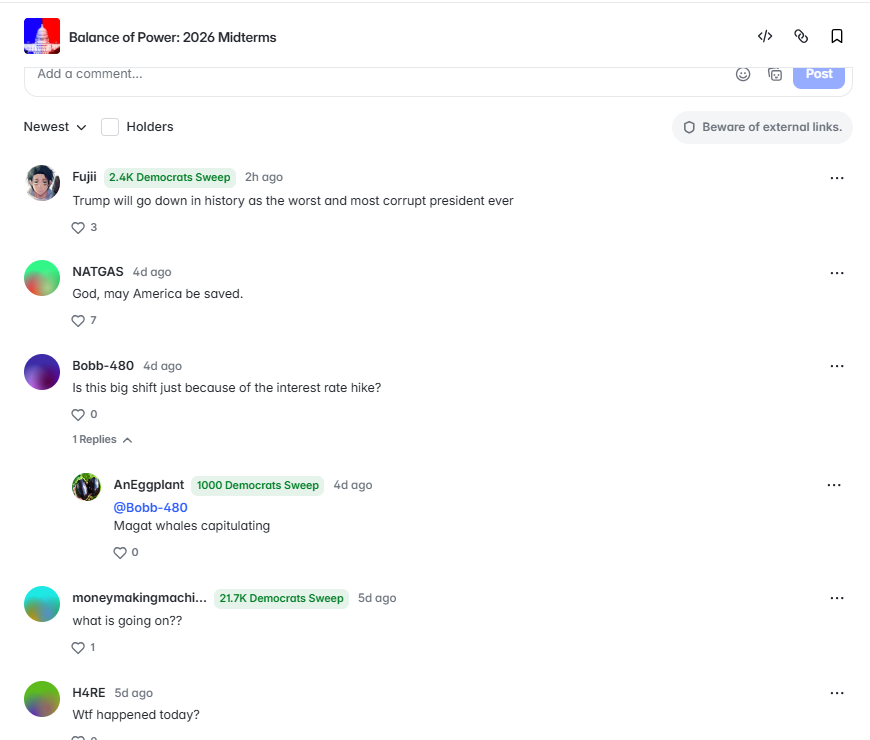
The comment section is unusually revealing — not because comments predict elections, but because they show how confused and reactive traders have become as prices move.
A holder of the Democratic sweep contract reacted to the recent movement without identifying a specific cause.
Another trader noticed an abrupt enough move to ask what event had changed the market.
This comment shows traders attempting to connect macroeconomic developments with the election pricing.
One user offered this as an explanation in reply to another commenter. It should be treated as a user’s interpretation, not established fact explaining the price move.
What Traders Appear to Be Pricing
The current Polymarket board can therefore be read as a combination of several layers.
First, traders are observing a national political environment that has recently looked more favorable to Democrats in some national polling.
Second, they are translating that environment into expectations for individual House races.
Third — and most importantly for the sweep contract — they are deciding whether the same environment is strong enough to carry multiple Senate contests at the same time.
That third step is where much of the uncertainty remains.
Why the 31% Split-Government Scenario Still Matters
The second-largest contract is not a Republican sweep.
It is a divided result: Republicans control the Senate while Democrats control the House.
At around 31%, this remains a substantial part of the market.
That pricing illustrates an important point. Traders can believe Democrats have a favorable environment for House races while simultaneously viewing the Senate map as more difficult.
The two chambers have different electorates, candidates and geographic structures, so they do not have to move together.
Why Is a Republican Sweep Only Around 8%?
The Republican sweep contract requires Republicans to retain or obtain control of both chambers.
Its current displayed price of approximately 8% indicates that traders are assigning substantially less probability to that combination than to either a Democratic sweep or the Republican-Senate/Democratic-House split.
Recent national polling showing a Democratic advantage on the generic congressional ballot is one piece of context that may contribute to that pricing.
At the same time, Republican-aligned groups are spending heavily in competitive races, and individual Senate and House contests remain capable of diverging from national averages.
That is why an 8% price should be read as a market estimate at this moment — not as a statement that the outcome is impossible.
ISHOWNEWS Market Comment
The most interesting part of this market is not the headline 63% number by itself.
It is the structure underneath it.
The market currently gives significant weight to two outcomes in which Democrats control the House: a Democratic sweep and a Republican-Senate/Democratic-House split.
That suggests the House side of the equation is playing a major role in current pricing, while Senate control remains an important source of uncertainty.
The correct way to follow this market is therefore not to ask only, “Will Democrats sweep?”
A better question is: Which component of the sweep price is moving — House expectations, Senate expectations, or both?
Watching those related markets separately can reveal much more than staring at the headline 63% contract alone.
Three Numbers Worth Watching Next
| Indicator | Why It Matters | What to Watch |
|---|---|---|
| House Generic Ballot | Gives a broad measure of the national congressional environment. | Whether the current Democratic advantage narrows, holds or widens. |
| Senate Battleground Polling | The sweep contract requires Democrats to win enough individual Senate races, not just perform well nationally. | Movement in competitive states rather than one national poll. |
| Market Split-Control Price | The 31% Republican-Senate/Democratic-House contract acts as an important alternative to a full Democratic sweep. | Whether money moves from the sweep contract into divided-government outcomes. |
Could the 63% Price Move Quickly?
Yes.
Political prediction markets can move after new polling, candidate news, economic releases, debates, scandals, major international events or large trades.
The closer the election gets, the more information the market has to process, and prices can become particularly sensitive to state-level polling and campaign developments.
For that reason, today’s 63% should be treated as a snapshot of trader expectations rather than a fixed forecast.
What the Market Is Saying Right Now
As of this snapshot, the largest displayed probability is a Democratic sweep at 63%.
The market’s second-largest scenario is divided government, with a Republican Senate and Democratic House at approximately 31%.
A Republican sweep is around 8%, while the reverse split — Democratic Senate and Republican House — is priced below 1%.
Taken together, those prices show where traders are currently allocating probability across different congressional-control combinations.
They do not tell us with certainty what voters will do in November.
That distinction is exactly what makes prediction markets interesting: the number is not the final answer. It is a continuously changing measurement of what participants are willing to pay for uncertainty.
FAQ: Polymarket 2026 Midterm Odds
Watch the Probability Move in Real Time
Prediction-market prices can change as polling, campaign news and trader positioning evolve.
Explore Polymarket